

Growing Against The Grain
A local food producer has been shortlisted in the prestigious BBC Food Awards.
Fresh Flour was nominated by customers and this week founder Andrew Gilhespy gave Zoe Clough a tour of the factory floor ahead of the results.
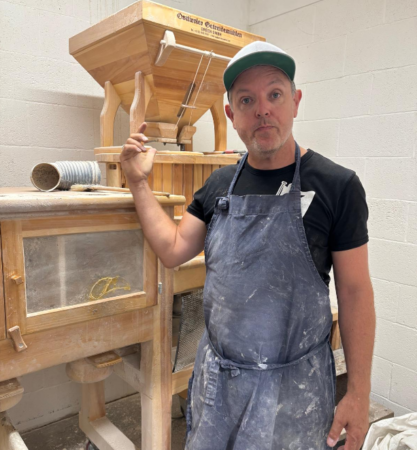
Picture a typical flour miller and you might think Camberwick Green’s Windy Miller or a sturdy peasant standing by a creaking water wheel. Not a baseball cap-wearing guy on an industrial estate in Buckfastleigh, next to a yurt maker.

Andrew Gilhespy changed his life when he quit Amazon, then quit Tesco, where he sold digital advertising. He came to Devon in 2015 with his wife and tiny daughter, looking for a community in which to put down roots.
“What is sustainability? What is life? You can either do one of two things. You can go on that treadmill and get more money, and consume more, or you can reduce your outgoings and say I don’t need as much. We were in a beautiful house in Peckham,” “…it was really run down, I was just lucky enough to live in an area that hadn’t been gentrified, but was on the way – so yeah I was that white guy doing the gentrification! But I was from the area… I grew up in Lewisham. We were paying loads of money for the mortgage.. and my daughter was born and we had even less money. My wife Helen got mugged … it was time to get out. ”
Andrew explains; “I had some money from a recruitment company I was running…basically just moving my mates… but it got boring. Sustainability was really important for me. I had grown up growing food, my mum and dad had three allotments at the back of our council house…potatoes, blackcurrants, pears, runner beans and it was great. ”
Because we are going against the grain
“From the age of five I had a little bit of the allotment, I planted stuff …learned how to do composting, how to grow asparagus, cucumbers, but at the same time I didn’t have time to do all the watering and thought annuals were a waste of time. Then I discovered Martin Crawford and his agroforestry garden down here and went on this little bit of a journey. One of my friends was coming to study economics at Schumacher and there was am MSC in food systems – it had my name on it…”

“So we were ‘right let’s get out of London’ …but everywhere seemed racist, homophobic and sexist, so I don’t want to live there… you get all of that in London but you also get a melting pot of people and culture. So then we arrived at Schumacher and well it’s different, but it’s very middle class. The students were from all over the world which is brilliant but – it cost £20,000.
My dissertation was about the wheat bread making industry in the SW and my hypothesis was bread can be made from wheat grown in the SW. Most people say no it can’t, the South West is for growing animal feed. But my research found a grain called Devon red blue chuff, so there must be a heritage of that. It’s got Devon in the name! ”
“My argument was the reason Devon was seen as a non wheat growing area was it was wetter in the winter, it was also hillier, which made it difficult for big tractors. Unlike East Anglia. But wheat will grown anywhere. The Devon wheat likes it a bit wetter.
So then you ask, what is it suitable for? Most artisan bakeries get grain that comes from Canada, Kazakhstan, Ukraine. We are fairly self sufficient in grain in the UK, but not organic grain. Then that grain gets milled at Shipton in the Cotswolds and a mill in Dorset… these are second tier mills but they are still big.”
“My argument with this is what we should be doing is localising our grain supply. Climate emergency is on us. Schumacher strongly believed that right at the centre of our problems is we think the whole universe centres around the human, and it doesn’t. We are tiny, we are insignificant. And we have built a system which is dominated by white, psychopathic men! And we need to dismantle that and we need to be more based on intuition, more feminine. From the basis of that I built a business to answer those problems.”
“We are a not for profit set up in 2019, just as the pandemic was setting in! We buy organic wheat grown locally, pay farmers fairly, and process it into everyday high volume products like pasta. There’s no point producing stuff that people buy in a small scale. Wheat is the most grown product in the northern hemisphere, it’s the product that is most tightly tied to humankind.”
Andrew did try to grow wheat himself, in a field in Dartington….
“I put a tonne of wheat into the field and two years later I had like two buckets. It’s meant to go the other way, right?!
Because I was feeding all the slugs, the snails, the rats, the rabbits, the mice, the birds.. then in the end I was like, well I’m not going to grow wheat.”
He then planted fruit trees and had chickens. But he realised he was trying to do everything and not doing anything very well.
“What we should be doing is opening up the mill and the baking to the community, like they do elsewhere but we have totally lost.
My big idea is we will put mills and making facilities back into farms, into towns around the UK. Mills were here before the Church. So it is there in our psyche.”
But I ask, how do you do that in, say inner city Birmingham? Put a mill into a disused shop. No shortage of them, he says.
(Totnes had two town mills, the one remaining building is next to Morrisons.)
Andrew realised that making flour was not the best business and that what he needed to do was make products from bought in grain.
In his unit in Buckfastleigh he has two mills, one French and one a splendid Austrian contraption made from sandalwood to repel bugs, which are a natural byproduct of storing grain and making flour and happen to love this hot weather – which is why much of his supplies are now stored in fridges. Both mills are small enough to fit into an average bedroom.
The flour I saw, made from a grain called April bearded, is silky smooth, so fine it’s like luxury face powder.
The bran which is left gets milled again and then made into a ferment – sour to my taste – which he uses in biscuits made with butter and cocoa husks – which are a byproduct of the chocolate industry – that he grinds in the Austrian mill. And they taste great. Possibly if you love a chocolate digestive, they won’t be sweet enough but they’d stand a dunking in your cold-pressed organic flat white.
Like many small firms, his business walks the tightrope between being too small and niche, or feeling forced to grow and sell to supermarkets, to which Andrew makes an Over-my-Dead-Body face.
Fresh Flour pasta ,crackers and biscuits are sold in Totnes and in London but Andrew’s dream is (apart from a mill in every town) to open a factory/shop/restaurant.
“So if you imagine this is cut in half with a glass wall down the middle and you’ve got your production. So you can see the miller working, you can see the pasta being made. In the morning, have some toast or the porridge we have milled. And then in the evening you’d be able to come and eat the pasta and pizza. Make it so that people can afford it, buy the product at wholesale prices. Pay what you want for the meal.”
But idealism needs funding, and money is like his wheat harvest –in short supply.
“At the moment I have 86 pounds in my account. I’ve paid all the bills and I’m waiting to get paid, because it’s tight. So I have to go and chase people to get more money in the bank. It’s worrying, then it’s ok….cash flow is always the problem. So I need to find enough money to employ someone full time to do the packing and making with me, so I can sell.
“Because we are going against the grain, the food industry don’t want to invest in us. And we don’t want to be part of that system.”