
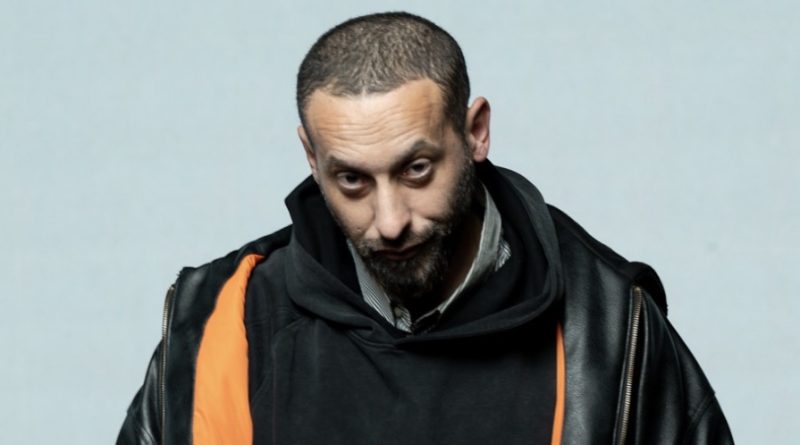
The Beat Never Goes Off: Tamer Nafar, Pioneer of Palestinian Hip-Hop, Returns to Totnes
The Palestinian rapper, actor and activist who sold out the Barrel House Ballroom last summer — then performed at the Barbican the very next night — returns on July 23rd
There is a story Tamer Nafar tells about making a music video. His producer friends wanted police, flashing lights, the whole spectacle — expensive to stage, logistically complicated. Nafar told them not to worry about it. All they needed to do, he explained, was walk out into the street waving Palestinian flags. The authorities would show up on their own. They could shoot the video for free.
The plan worked.
It is a story that contains, in miniature, everything that makes Nafar so arresting as a performer: the dark wit, the political acuity, the refusal to be defeated, and the understanding that absurdity and injustice are not always easy to tell apart. That night at the Barrel House Ballroom last June, a sold-out crowd — with people hunting for last-minute tickets outside and others unable to get in — sat transfixed for the better part of two hours as he unpacked that world with humour, music, personal history and a disarming frankness.
Now he is coming back. And this time, the show is finished.
Tamer Nafar was born in 1979 and grew up in Lyd — known in Israel as Lod, a mixed Arab-Israeli city roughly twenty kilometres from Tel Aviv, long marked by poverty, drug trafficking and the particular weight of contested identity. He discovered hip-hop at seventeen, learning English by working through Tupac lyrics with a dictionary, and by 2000 had co-founded DAM with his brother Suhell and their friend Mahmood Jreri. The name is a layered piece of linguistic architecture: an acronym for Da Arab MCs, but also the Arabic word for “lasting” or “persisting,” and the Hebrew word for blood. Eternal blood. We will stay here forever.
I felt closer to a reality I could never fully understand
Their breakthrough single Who’s the real terrorist? (“Meen Erhabi”), released in 2001 — was distributed by Rolling Stone France and downloaded more than a million times. Le Monde called them “the spokesmen of a new era.” They shared stages with titans of the form — GZA of the Wu-Tang Clan, Mos Def, Talib Kweli and Chuck D of Public Enemy — toured Womad and the Sundance Film Festival, and became — without quite intending to — the sound of a generation.
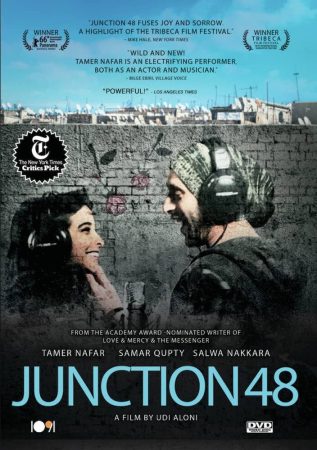
Nafar also co-wrote and starred in Junction 48, the award-winning film directed by Udi Aloni, which premiered at the Berlin International Film Festival in 2016, winning the Audience Award, before taking Best International Film at Tribeca. He plays Kareem, a rapper navigating love, loss and political pressure in a city caught between two identities — a character drawn closely from his own life. Local audiences may already know it: the film was screened in both Totnes and Ashburton, presented in association with Totnes friends of Palestine, and it remains one of the more vivid introductions available to the world Nafar inhabits and the pressures that shaped him.
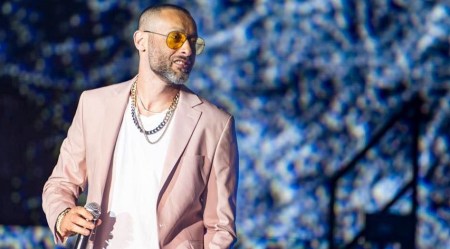
The show coming to the Barrel House on July 23rd is called *In the Name of the Father, the Imam & John Lennon (Revisited) — a title that gives you a reasonable map of the emotional terrain. It is built around the relationship between Nafar and his father Fawzi, a man who kept his head down through decades of displacement and difficulty: playing in a wedding band, working as a postman despite being unable to read, installing boilers until an accident put him in a wheelchair. For a long time, Nafar saw his father’s quietness as an absence of resistance. The show is partly about what it meant to understand, eventually, that he had it completely wrong.
It is also about John Lennon’s Imagine — a song Nafar describes as something close to a personal creed — and about the complicated, often painful space between that dream and the daily reality of being a Palestinian living inside Israel. There are songs, video interludes and conversations with the audience. There is, as Nafar has put it himself, “politics, humour, sensitivity, therapy.” People dance. People cry. Sometimes at the same time.
When Nafar brought the show to Totnes last June, it was still being developed — refined in real time, finding its edges. That particular night became, by his own account, a significant moment in that process. The following evening, he performed with DAM at the Barbican Hall in London as part of the Shubbak Festival, Europe’s largest platform for contemporary Arab arts.
What he is bringing back in July is the version of the show that emerged from all of that — developed, deepened, complete.
“That was a tank attack,
That was a gas attack,
Never a heart attack,
Because the beat never goes off”
It is worth pausing briefly on the context. Last June, a ceasefire agreed in January 2025 had already been ended in March by a surprise Israeli offensive, and the war was fully back in motion. Independent analyses released around that time suggested that the true Palestinian death toll was already well above the official figures, with estimates ranging towards 90,000 deaths. Since then, a further ceasefire came into effect in October 2025 — but the killing has not stopped. More than 1,000 Palestinians have been killed in Gaza by Israeli military action since the ceasefire was declared, with airstrikes, gunfire and shelling continuing despite the supposed truce. Roughly a child a day on average. More than 100 Palestinians have also been killed in the West Bank by Israeli forces and settlers during the same period. As global attention shifts towards other conflicts, the UN Human Rights Chief said in April this year that it was “hard to square this with a ceasefire.” The officially recorded death toll in Gaza now stands above 73,000, a figure broadly accepted by both the Gaza Health Ministry and Israeli authorities, while the true toll is widely understood to be substantially higher.
None of this is backdrop. It is the ground Nafar walks on.
That context shaped who came to the Barrel House last June. It was a wide-ranging crowd in age and background, drawn together by solidarity with Palestine. For many who arrived primarily out of political concern, the musical dimension turned out to be a surprise and a delight. Several remarked afterwards that they had connected with the music far more than they had expected — that hip-hop, encountered on its own terms, was precisely the right form for what Nafar was saying.
“I went to this gig with no expectations,” said Amber Louise, who was in the audience that night, “but what stayed with me wasn’t just the talent — it was the performer’s extraordinary strength, courage and vulnerability. Through the music, I felt closer to a reality I could never fully understand, and I was deeply moved by both the raw honesty and the privilege of witnessing it. Powerful, thought-provoking, incredibly clever, and beautifully balanced with humour throughout.”
That evening, Nafar invited questions from the audience — and it was in these exchanges that many of the most striking moments emerged. Stories were drawn out, tangents opened up, the room became something closer to a conversation than a concert. When someone asked how he maintains hope, his answer was unvarnished: he doesn’t. There is no hope. He spoke about therapy, about healing, about the necessity of being permitted to grieve — the right to suffering as something to be acknowledged and moved through rather than suppressed. There were dark jokes, which landed. There were stories — about his father, about growing up in Lyd, about the strange bureaucratic theatre of daily life under occupation — whose conclusions this article will not give away, because their power depends on hearing them in the room. The audience was with him throughout: attentive, engaged, moved in turns to laughter and to silence. And then, without softening the landing, he said it plainly: there is a genocide taking place. Not as a rhetorical flourish, not as a prelude to something more hopeful. As a fact, stated and left to stand.
For those who came reasonably well-informed about the Palestinian situation, the evening offered something harder to find than facts: nuance, lived texture, the specific gravity of one person’s history set against the larger one. Even those who had followed events closely found themselves learning things — not just about what is happening, but about what it is like. That distinction matters.
Tim Bennett, Mayor of Totnes, was there. “Tamer Nafar’s last appearance in Totnes was a real surprise: eloquent, funny, and deeply personal. It is not simply a hip-hop show, although there are definitely some bangers, it is storytelling, music and reflection woven together with warmth and charm, and I would strongly recommend it even to those who might assume it is not for them.”
There is other new work that speaks to the same preoccupations. Nafar recently released a cover of Akon’s “Lonley” sung in Arabic — a strange and affecting recontextualisation in which a pop song about romantic isolation becomes something far more desolate and politically charged. In a message to his mailing list, he was characteristically direct about what it meant: “During the last few years of genocide, and no one to hold in charge, I, as a Palestinian, felt orphaned and lonely.” The word orphaned is doing a great deal of work there. It describes not just personal loss but a kind of political abandonment — the experience of watching the world’s institutions fail to intervene, of being left without the protection that others take for granted. He added: “I hope running to shelters is behind us, and that we can return, even for a moment, to focusing on creation and life, not only war and death.”
He has also been writing regularly for Haaretz — Israel’s oldest daily newspaper, known for its left-liberal editorial stance, read closely by the country’s intelligentsia and by governments and embassies internationally — and for +972 Magazine, an independent non-profit publication run by Palestinian and Israeli journalists, committed to reporting that challenges mainstream narratives on the occupation, and occasionally for The Guardian.
At the previous Totnes show, Nafar screened and talked through his collaboration with MC Abdul — Abdel-Rahman Al-Shantti, a twelve-year-old rapper from Gaza whose freestyles went viral during the May 2021 bombardment, shared widely by figures including Bella Hadid and, in one of the more bewildering footnotes of recent cultural history, Ivanka Trump. Their track, “The Beat Never Goes Off” released in 2021, was recorded remotely across the physical separation between them — Nafar in Lyd, MC Abdul unable to leave Gaza — with the boy projected onto a wall behind Nafar in the video, the barrier itself repurposed as a screen. The story of how it came together is one of the more quietly extraordinary things Nafar shared that evening.
“That was a tank attack,
That was a gas attack,
Never a heart attack,
Because the beat never goes off”
And then there is the book. 3Gs: An Imaginary Memoir — due out this December, and available to pre-order now — is described by the Los Angeles Times, which has previously called Nafar “the Chuck D of Palestinian hip-hop,” as a work of “stunning originality and kinetic energy.” It follows three generations of the Nafar family: Fawzi, Tamer’s father, who carries the memory of the 1948 expulsion in his body; Tamer himself, who carries it in his voice and refuses to leave the city that shaped him; and Shaden, a future daughter who returns to a Lyd that no longer exists as a physical place, to save its memories for a Palestine preserved beyond the reach of conquest. It is the work of someone who has spent a great deal of time thinking about what stories are for and who they belong to. The fact that it arrives in the same year as the refined show is not a coincidence. This is an artist consolidating a body of work.
Joel Mcilven — MC Appljuc, host of local hip-hop night Totnes Hotness — was at the June show. “Tamer’s previous show was one of the most profound gigs I have been to,” he said. “As a Palestinian living in Israel, the experiences Tamer describes seem almost beyond the comprehension of most people living in Totnes. But his intelligence, charisma and humour helped renew my understanding with humanity and nuance. He is the embodiment of the rapper-as-scholar and teacher, and demonstrates that hip-hop offers inspiration, hope and connection to everyone who believes in a juster world.”
There is something worth naming about the remarkable singularity of an event like this taking place in Totnes. The scale of the history and suffering from which Nafar’s work emerges — the Nakba, the decades of occupation, the ongoing catastrophe — arrives into a small Devon town and fills an intimate room above a pub. Nafar could fill a space many times the size of the Barrel House Ballroom. That he comes here, and means it, is something to sit with.
Tickets for July 23rd are on sale now. On the evidence of last time, they will not be there for long.
Tamer Nafar performs at the Barrel House Ballroom, Totnes, on Thursday July 23rd. Doors 7.30pm, start 8pm. Click here to buy tickets
3Gs: An Imaginary Memoir is available to pre-order now.