
Sailing for Trade
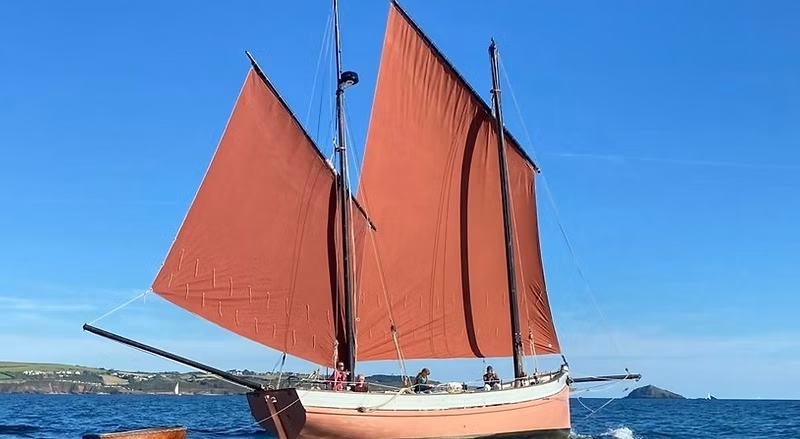
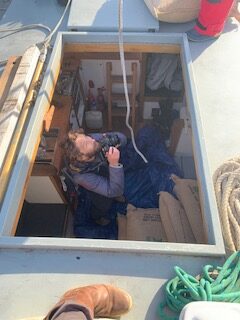
 At first sight, it looks like nothing more than a mediaeval pageant, a reconstruction of historical events of the type that seem to be increasingly popular in recent times. The Ibis, an elegant double-masted ship dating back to the late 1920s, is moored in the harbour here at Plymouth. Cases of produce are being wheeled and carried down the gang-plank by a team of young people, most a little wobbly on their pins as they rediscoverer their land-legs. It is clear there is an educational element to the trip as senior members of the crew guide the younger ones in how to take down and fold the sails and in the use of knots appropriate for different purposes.
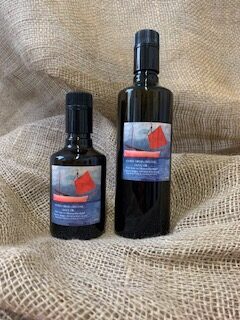
Then, as we draw closer, it becomes clear that a sufficient weight of produce is being downloaded for the trip to have a serious economic dimension. The foodstuffs making their way onshore look and smell ravishing – olives, red onions fairly bursting out of their skins, turmeric, line-caught tuna, coffee, figs, salt. The documentation on the cargo sheets reveals a range of countries of origin – most notably France, Portugal and the Azores. I recognise one of the labels as Yallah Coffee, the radical, low-impact single-origin coffee that I subscribe to. (All of the other goods carried by the Ibis, I learn later, have been carefully sourced as originating from organic and ethical producers.) The produce is being divided up and dispatched by rail to various destinations in the south-west.
There also seems to be a touristic dimension to the operation, as a small group of holiday makers are being ushered on board by their tour guide. She is moving effortlessly between various languages, rehearsing an introduction to the day’s trip over to France polyphonically.
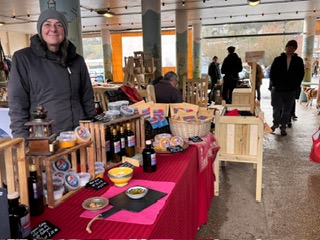
I introduce myself to the woman who seems to be the fulcrum around which all these activities revolve – a human dynamo by the name of Barbara Bridgman. When I tell her that I am visiting from Totnes, her face lights up; the Friday and Saturday markets in Totnes, she tells me, are among her most important outlets. Barbara is Italian, from the small Tuscan island of Monte, where her family has worked the land and lived off the sea for generations. She got the idea for her ‘Sail Trade’ venture from travels in Europe where the model is much more developed and recognised than in the UK.
 When I ask her whether, at heart, the venture is primarily about food, education or tourism, she hesitates before replying, ‘it is about all of them equally. They mutually reinforce. Take, for example, the community-building that happens among the crew members as they learn about both the technical and emotional dimensions of working cooperatively together.’
And as for the economic rationale of Sail Trade, she points out that trade in north-western Europe and the Mediterranean has taken place under sail for much, much longer than by vessels powered by fossil fuels and that we would do well to hold onto the skills that we retain that make this possible.
 And on her motivation for working on such a small scale, with the thin and vulnerable incomes inherent, she replies proudly, ‘I want to wake in the morning with a clean conscience.’
The only significant downside to the operation is its non-reciprocal nature. That is, while there is plentiful demand in the UK for quality produce originating on the European mainland, the Ibis has failed to date to identify produce originating here in England for which there is much demand further south.
The last time something similar happened, it did not end well. When the emperors of the Chinese Qing dynasty in the mid-19th century failed to identify any goods originating in the west that were the equal of the clearly superior Chinese produce, the East India Company responded by having great quantities of opium smuggled into China, thus forcing the market open at the nozzle of a gun.
There is little indication for the moment that the activities of the Ibis represent a similar threat to the global economy. Nonetheless, the precautionary principle suggests that we should be doing all we can to help Barbara to fill up the Ibis’ holds for her return journeys south.
The Sail Trade website can be found here https://www.sailtradesouthwest.org.uk/