

A Heartfelt Farewell to Old Monterey Pine – Pinus Radiata at the Old Postern
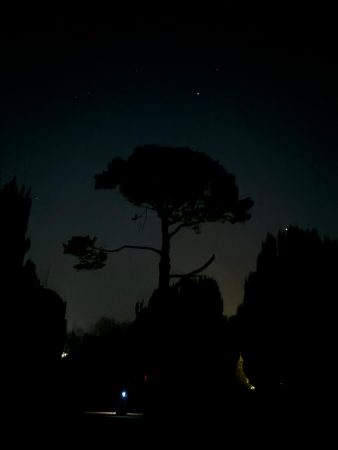
If you have ever driven, cycled or walked to or from Dartington Estate along the Higher Drive, past St. Mary’s Church, you will have gone past an impressive and beautiful tree that is soon due to depart.
The Old Monterey Pine outside The Old Postern is a towering and peaceful presence – formal name Pinus Radiata. When I worked at Schumacher College at the Old Postern, we regularly saw the Dartington Garden team checking it over, to monitor its health and we were told it would be a matter of time before it was not deemed safe to inhabit that space anymore.
It seems that time has come, as just before Christmas the local community on the Dartington estate were informed that the new tenants of the Old Postern, Redwood River School had commissioned a tree survey and had been advised that the tree was no longer safe to live where it is and would need to be cut down before Christmas.
All parts of the tree are going to be used
Hearing this news, some local Schumacher College alumni, current faculty and others helped put a temporary Tree Preservation Order on this much beloved pine, to do everything possible we could to help our tree friend survive (as Schumacher College called The Old Postern their home for 30+ years, this tree feels like part of our college family). The Tree Preservation Officer at the council then was in contact with the school and requested an additional Tomograph survey, an imaging method that builds up a picture of internal structures by taking many measurements from different angles and reconstructing them into slices. These slices can then be stacked to form a 3D image. The results that came back confirmed the same picture of the original tree survey that the school had obtained from a reliable local firm in November.
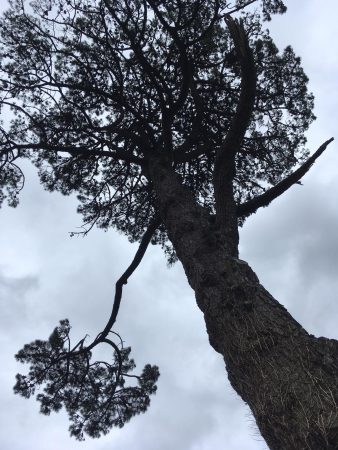
So following various visual inspections, surveys and risk assessments made with the over-arching goal of assessing our tree friend’s ability to “withstand the range of normal weather events that might reasonably be expected to occur”, the long and short of it is that there is a serious risk to the tree falling at some stage and the location of where the tree lives (by the school main entrance, the on-site car park, and the playground area) means humans could get hurt if the tree falls when they are around. In rather drier risk assessment terms “According to the QTRA framework, this tree presents an unacceptable level of risk”.
From the tree report we can see that our beloved tree Monterey Pine “has an approximate height of 22 metres and a stem diameter at 1.5 metres above ground level of 1900mm. The tree has an approximate crown radius of 8 metres. The tree exhibits fair vitality, with a moderate amount of needle material present. Needle density is primarily concentrated in the upper canopy, with reduced distribution in the lower crown. Evidence of two previous limb failures was observed in the northern canopy at heights of approximately 8 metres and 9 metres.”
When you read the above you could think that it sounds quite healthy (except perhaps for the limb failures). The report then goes on to talk about a fungus that is in the roots of the tree.
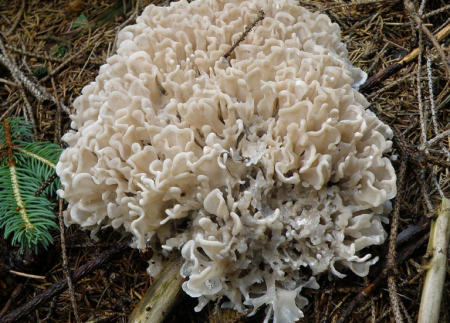
“Cauliflower Fungus (Sparassis crispa) was observed at the western buttress roots of the tree. Sparassis crispa – impacts trees mainly through parasitism, causing wood decay and weakening the structural integrity of infected trees due to a cubical brown rot of wood. It primarily targets evergreen trees, and its presence might also indicate tree health issues. It is subterranean and usually only infects the rooting material of trees, however decay can ascend the main trunk of the tree. The decayed wood has little tensile strength. Extensively affected trees are liable to brittle fracture at the stem base.”
“A previous root investigation recorded minimal decay; however, that assessment focused on an area separate from the current location of Sparassis crispa. Since that time, additional signs of fungal activity have developed over a relatively short duration. As a result, the percentage of the root system potentially affected has increased substantially. (…..) in light of the extensive fungal fruiting bodies observed annually and the documented history of branch failures. These factors collectively indicate a sustained and progressive decline”
The additional Tomograph survey also found “slowing sound waves (coloured blue) in area of 56% of the stem. Slowing sound waves are indicative of decay and dysfunctional wood which would increase the likelihood of failure. (…..) and the observed dysfunction on the northern aspect of the main stem, along with reduced vitality on the northern side of the canopy, correlates with the decay indicated by the tomogram.” and “The Monterey pine assessed is a mature tree. The species generally exhibits an average life expectancy of 80 years, with 100 years considered the upper limit for a healthy specimen. Given the recorded stem diameter of approximately 1,900 mm, the tree’s age is estimated to be in the region of 80–90 years. This assessment supports the conclusion that the tree is now within the terminal phase of its expected life cycle. This is consistent with expected end-of-life characteristics for Monterey pine, including the progressive failure of lower canopy branches, which in this instance reflects the tree’s advanced age and maturity.”
The news about our tree friend is hard to hear in a lot of ways, as we may ponder or consider that if this tree was in a field or forest somewhere, then it may live out its mature life in peace with all the organisms and animals that call it home and that perhaps these underground fungus are not going to make the tree fall down and perhaps it would never hurt a human being. Ultimately Tree Risk assessments have an intention to protect human beings – although an ecologist has to be sought to check the tree for impact on wildlife before felling.
Some of us may feel that generic/ standard tree risk assessments would ideally have a wider perspective and finer tuning, to include and care for the non-human world more equally and some of us may not agree with the things at all. Personally I like to think that collectively we are all learning how to better care for our world more and more and even when all is said and done, I can see the compassion and the care that is in a generic risk assessment. I can understand why what’s being done is happening.
we are all learning how to better care for our world
I have spoken to the caretaker Pete at the Redwood River School and he is very fond of our old pine and he feels very connected with the other trees on site and the nature around the Old Postern. It is nice to know that he cares for it in a deep way and he has told me about all the plans for after it’s towering physical presence has gone. “All parts of the tree are going to be used onsite with the exception of any wood that will be taken by local folks with a connection to it such as Landworks and Schumacher College.”
“We will be using the main trunk for our students to play and sit on, they will be placed on the lawn in their natural state and over time I see them being used as an educational point of interest for many lessons. The large section at the top where all of the larger branches grow out will be positioned on site and be used by the art department for display and sculptural inspiration and I’m sure many, as yet, undiscovered artistic creative uses.”
He continued “The smaller branches will be used to create habitat piles on the far side of the lawn which has undergone significant work and is now being rewilded with significant patches being given back to nature to support the site wildlife. The small twigs and canopy will be chipped and used as mulch to feed and protect the roots of the large chestnut tree on the driveway. The mulch will also be used to place around the base of the 400 new trees and hedgerow plant that we have planted throughout the site throughout this Autumn and winter.”
The school also plan to plant a new tree on the same site in the future which will be a tree species that is well-suited to local soil conditions, light levels, and the natural character of the area – a Dawn Redwood (Metasequoia glyptostroboides).
Funnily enough, Satish Kumar the founder of Schumacher College planted 2 dawn redwoods only last month when he was visiting an ecological community near Shanghai, by some Paddy fields. He suggested the trees could be named ‘Love’ and ‘Peace’ and were to represent India and China. It will be nice in the future to hear what the new dawn redwood at the Old Postern may be called!
Our dear old friend Monterey Pine or Pinus Radiata is set to be taken down on Monday 13th April 2026. If you know and love this tree then you can visit it outside the school gates before it departs. If you read this article after the 13th, please know that a small ceremony organised by friends of the tree from Schumacher College will be taking place before the tree comes down (in coordination with the Redwood River School) and we will be blessing and thanking the tree for it’s time with us all.
Gratitude and love for the tree will be expressed for those who were friends with the tree and didn’t know the tree was leaving us so soon and couldn’t get there in time to say goodbye.
Thank you, Grace, for such a beautifully written and balanced account of what is happening and why. A very refreshing approach.
Monterey pines may be loved but not native to Devon …oaks are