

Three Years On – Dartington Estate – An Open Letter
Open Letter to The Pulse, Totnes 29-4-26 By William Murtha edited by Zoe Clough
The Dartington estate project
At the core of Dorothy and Leonard Elmhirst’s earliest vision for the ‘Dartington Experiment’, in the early 1920’s, they talk to a life unrecognisable from today’s pressures to balance finances and build relationships with local villagers. At one stage, commonfolk weren’t even permitted to wander the estate freely. It wasn’t an open green field space that invited unwelcome visitors. If you weren’t associated with the Elmhirsts or their grand vision for a future utopia, you tended to stay away. Contrast that with today. Oh, how times have changed.
Purchased for £30,000, their initial dream for the estate focused on creating a ‘many-sided life’, as Dorothy termed it. The initial hurdles facing the married couple appeared overwhelming. There were few roads laid down, no electric, plumbing throughout the estate was questionable, numerous buildings were falling into disrepair, and then there was the collapsed roof of the medieval Great Hall to contend with, which sat at the very heart of the estate.

Undeterred by challenges that put off other potential purchasers at that time, the Elmhirst’s goals never lost sight on creating a culturally diverse hub where learning, person-centered growth, connection to the land and living abundantly could flourish together in harmony. A key aim for the American heiress and her Yorkshire born second husband, Leonard, was to create a utopian life of personal mastery and artistry. They envisioned a living environment where people invited to Dartington, from all corners of the world, could flourish in every area of their lives. Passionately believing that a practical, experiential life should also include time for expanding the mind with new ideas, the couple vehemently argued that inspiring the heart and connecting to the great outdoors, would help individuals to attain fulfilment and wholeness.
Had Dorothy (nee Whitney) Elmhirst rocked up at Dartington today, in 2026, her inherited wealth, allowing for inflation, has been estimated to equate to a vast fortune, with speculation ranging from anything between a few hundred million and something close to one billion pounds in today’s money. Regardless of the actual amount, a still staggering amount of inheritance for a young woman, to commit to cultural innovation and social causes she passionately believed in for a new world.
Unfortunately, for modern day Dartington estate, philanthropists like Dorothy, with a strong social and moral conscience, don’t come around too often. She was, as noted biographers have captured, unique in her driven desire to create a melting pot for pioneering ways of living. It was the roaring 1920’s, remember, and following the gloomy desperation and darkness of World War 1, much of the planet was thirsty for a reboot to help usher in a better, fairer and more connected world.
One of the wealthiest couples in the country, their passion circled around bringing the great minds and gifted artistic talent of world together, all with the noble intention of helping society to become more just and egalitarian.
Fast forward a century, and Dartington Trust carry the unenviable burden of Dorothy’s legacy looming over them. Identical challenges faced both groups, only separated by a century. Namely, how to balance the books, and run a large, financially hungry estate, all whilst trying to be ethically good neighbours to Dartington folk.
When Dorothy Elmhirst took what was to be her last stroll across her beloved courtyard, to retire early after not feeling well, in the lead up to Christmas, 1968, I wonder how much time she gave to pondering about Dartington’s complex future, once she would be gone. The next morning, on Sunday 14th December, a distinct heaviness drifted across the silent estate, as word spread of her passing. At that evening in the Great Hall, an empty chair solemnly marked where she would normally sit, lovingly marvelling over the evening show delivered by world class performers.
Running at a yearly loss became the norm
Anyone even remotely close to the practicalities, financial demands and the need to constantly invest in modern machinery and update buildings, knows that Dartington as a charity, has hobbled along on life-support for close to six decades since the ‘money tree’ disappeared. Of course, like a gambling addict skilfully hiding away their shameful mounting losses, previous teams and trustees did an exemplary job of masking over the true picture, since Dorothy Elmhirst died. Her passing not only signified a radical change of guard in the power structures of how the trust was set up and run. That unsettling and challenging period also marked the beginning of secret power struggles, bickering and in-house fighting, amongst trustees and other leaders, that on occasion would befit the family of the House of Medici. Power vacuums, especially involving money, control and personal preferences, rarely bring out the best in human nature. Read former head of Dartington Trust, Ivor Stolliday’s vivid and uncomfortably authentic account of how the trust operated in the decades following Dorothy’s death, and you’ll glean a flavour of just how toxic and disjointed the whole organisational structure was beneath the highly polished veneer.
Dartington at 100: an inside view of how the “profligate orphan” survived
Selling most of its most prestigious art collections and treasures, along with more and more of its greenfield landbank bordering Dartington village, the trust has somehow managed to pull off a close escape worthy of the illustrious stunt performer, Harry Houdini. All the best creative accounting in the world, cannot paper over the glaring facts that Dartington, ever since its conception, has never quite got to reasonable grips with running the whole enterprise sustainably. Without regular philanthropic handouts, national grants or frequent land and property sales, including profit making businesses, to draw capital from, it would never have survived so long. (*footnote. Art and property sales have continued under this management. Editor.)
With Dartington becoming overly reliant on annual sales of possessions or prime land, all to plug the ever-widening gap between the income they received from ongoing projects, and the money they were spending out on salaries and estate running costs, something had to eventually give.
Incensed at seeing their once quaint village transformed into multiple housing and commercial real estate, and choked by pollution, the villagers rightly started to rebel and fight back. The irony of the initial ‘Dartington Project’ was, the initial values laid down were meant to enhance local people’s lives. Not make them decidedly more miserable.
Finally confronting painful, inconvenient truths
When former Chair of the Football Association, and renowned Peer, Lord David Triesman, officially took over at the helm at the Dartington Trust in March 2023, he was part of a long line of new chairman and trustees determined to grab the core issues and turn things around for the better. On arrival, he must have wondered what on earth he’d signed up to. He landed hard in the hot-seat to quickly discover the Trust sitting on a mountain of rising debt, systems that were decades out of date, a disengaged workforce who had suffered decades of contradictory, ‘patchwork quilt leadership’, secret power struggles and infighting, some trustees with more self-interest than genuinely caring about the greater good of Dartington estate or village, all wrapped around a polished, cosy false veneer of ‘toxic-positivity’. This was also supercharged by an enraged local village community whose tolerance levels with the trust, after decades, had finally snapped. Increasingly antagonistic and suspicious of the Trust’s obvious lack of integrity, fuelled by decades of broken promises, no wonder local protest groups, like Save Dartington, and Don’t Bury Dartington Under Concrete, (where I was proudly part of both) started to swell. Enough was enough.

This is what confronted Lord Triesman in his early tenure – remembering that this was a man only months away from his 80th birthday celebrations.
The former Labour party Minister of the Department for Innovation, Universities and Skills, faced a daunting prospect. With the internationally renowned Dartington Trust close to celebrating its centenary year, as an ongoing charity it was facing an uncertain, scary future. There was a very real and imminent prospect of the trust sliding into administration. Even allowing for his eclectic experience in government and running businesses, the prospect of seeing Dartington estate possibly fold in that autumn, only months after joining, must have felt overwhelming. Thankfully, for Dartington’s future, be it good fortune, or wise counsel in attaining his services, (probably both) the right candidate was chosen to lead the Trust through one of the rockiest, yet transformative periods in its colourful history. To Lord Triesman, it mattered not whether it was indecisive leadership, naïve planning, inexperience, a lack of courage to deliberately face painful truths, in-house bickering over budgets, or the occasional all too big ego that ultimately contributed to the trust finding itself down a cul-de-sac. He got on with the job in hand, confronting the dire, yet certainly not new, predicament head on. Quickly pulling on board the best team of renowned turnaround and recovery experts available, which included London based, Buchler Phillips, Lord Triesman, along with interim CEO, Robert Fedder and their small team, wasted no time in tackling key operational and strategic issues.
A new mindset to make the estate sustainable
At one of the several meet ups I’ve had so far with Robert Fedder, I asked him what administration would have entailed. What would it look and feel like to long time committed staff, residents living on the estate, local villagers, day visitors and those with their businesses based around the estate, such as myself? Robert painted an honest yet bleak picture, outlining one potential roadmap if the estate had been forced into bankruptcy. One of the most likely outcomes, apparently, involved an overseas property investor taking control of the entire estate, for a nominal fee. With the ultimate aim of splitting up the Trust’s land assets and property portfolio into more manageable parcels, to maximise development options, the overseas speculators would have likely carried little regard for Dartington’s rich legacy, nor would they respect what the 1,200-acre site meant to the local population of Dartington and Totnes. To rub salt into the wound, the overseas opportunists and secret investors could have likely ringfenced the estate perimeter, preventing nobody access, other than residents living on the estate.
From day one of taking over in March 2023, the turnaround team, along with several committed trustees and external consultants and commercial partners, and not forgetting the core team of dedicated employees at Dartington, have faced a constant uphill battle to balance the finances, pay salaries on time, make the trust sustainable and attract new investment from outside. Having to make unpopular yet essential hard choices, by saying goodbye to long-term loss-making ventures, like Schumacher College and the Dartington International Summer School & Festival of Music, has not come without vocal criticism and condemnation. Having to drastically cut the number of full-time staff, to help the whole estate align with a more sustainable long-time business model, has also been difficult, especially with people’s livelihoods on the line. In some cases, staff coming off the Dartington payroll have managed to find employment with external subcontracting businesses who are now serving the Trust’s operational needs, such as cleaning staff.
In reality, and for almost half a century, Dartington Trust has never functioned fully as a stand-alone sustainable business model. If an honest financial analysis was run over Schumacher College, taking into consideration all hidden costs and expenditure, including the maintenance and upkeep of buildings falling into disrepair, it would mirror the same story. Both never quite reached a true self-sustaining status on paper. Neither operation would have ever managed to survive and then thrive on its own merit, not without the assistance of annual cash injections generated from either regular land sales, or in the example of Schumacher College, an ongoing agreement around a peppercorn rent, or even, in later years, no rent charged at all.

Local community
Many of us local activists have witnessed up close just how much hatred, friction and animosity has been ignited between Dartington villagers and the trustees and leaders at Dartington Trust. Relationships between both have ranged from cordial at best, to outright abusive and antagonistic at worst. Some leadership teams at the Trust, including Rhodri Samuels short time at the helm, have been genuinely more civil, transparent and respectful of locals’ fears and concerns about the Dartington village eventually being turned into one large housing and commercial estate. In one of the worst, most appalling and abusive recent cases of bad stewardship and toxic leadership, however, Dartington Trust had the audacity to compile an illegal ‘hit-list’ of protestors names. Anyone even perceived to be an agitator, anyone daring to call out the Trust’s nefarious covert behaviour, or secret behind-closed-doors deals, by naming uncomfortable, inconvenient truths, was ceremoniously blacklisted. In the quarter of a century of following the antics of Dartington Trust, I cannot recall a time like that when relations between villagers (including the Parish Council) and the Trust was more fractured, diseased and toxic.
Thankfully, for the sake of all, and with the advent of a vastly different business model being delivered from the leaders and trustees of the Trust today, relationships have improved exponentially. Thanks to the initial transparency of the late Lord Triesman, and with the growth mindset of interim CEO, Robert Fedder, bridges are being rebuilt. People from opposing sides of the argument now enthusiastically engage, share and deeply respect the views of one another’s point of view.
A three-year report card
Writing this around the three-year mark for the new stewardship at Dartington, I’m in deep reflection mode. Like a number of my fellow Councillors who I was fortunate to work with on the Dartington village parish council, deep-rooted cynicism has now been replaced by open dialogue and healthy scepticism. I stare across at the rundown building at Aller Park School in Park Road, directly opposite our office. Still stunning, even though it has remained empty for over 40 years, Aller Park is, like the abandoned Foxhole school, five minutes up the road. They represent a very different exuberant time when money worries weren’t a problem to Dartington. Both have sadly been left to rot, due to successive boards of trustees not quite knowing what to do with those buildings, or how to fund them.
Aller Park was built to an exemplary high standard of craftsmanship, almost a century ago. Using locally sourced natural quarry stone from the estate grounds, the former home of the progressive Dartington Hall School was one of Dorothy and Leonard Elmhirst’s early passion projects. One of its first of a kind in the UK, the experimental school embodied the deeply held values that the mega-wealthy couple believed in, when it came to attaining a ‘rounded’, experiential education.
Interestingly, the lavish designed property at Aller Park was laid out by the same designer who oversaw the build project of the Pentagon, in Washington DC, America. Architect Ides van der Gracht’s grand design involved some 300 labours on site, 200 skilled stonemasons and around 100 carpenters, from 1929 to 1931. Laid out to sacred geometry, which involves the building practice incorporating mathematical proportions-such as the Fibonacci sequence used on temples and many churches-into the layout and design, Aller Park still remains one of the most prized architectural gems ever constructed on the estate, bar the Great Hall.

Like Foxhole school, Aller may still be awaiting the time to be reimagined and repurposed, but other buildings across the wider estate, long overdue maintenance, are being renovated. Green shoots of recovery are popping up everywhere. Our offices here at Chimmels building, neatly sandwiched between Blacklers and Park school, are being repainted. The leaking roof has been fixed, the potholed carpark opposite is finally being dug up and re-laid. Testimony to the amazing work of Karen, Becki and the small property team, and coupled with external partners helping out on the commercial side, almost all the offices in this far reach of Dartington are now occupied, bringing in essential income. The Hex building, empty, cold and in desperate need of an upgrade, now houses On Track Education in a smart, redesigned layout. This resurgence is echoed across the estate. Long overdue repairs are happening. Roofs are being repaired, heating sorted, windows replaced. A new vitality is being slowly injected into the estate, after years of neglect, due to a severe lack of funds. The occupancy rate for available rental space on site now sits at an astonishing 95%.
Redwood River School, a specialist dedicated to nurturing young people’s development, which has taken up the space left behind by Schumacher College’s inevitable departure, now operates out of a modernised, fully refurnished set of buildings at Old Postern. Busby & Fox’s HQ has now firmly settled at what was the defunct, High Cross House. And not forgetting Dartington’s most visual example of the new landlord model, sitting at the epi-centre of the estate. The Green Table Cafe, now leased by popular entrepreneur and owner of local village pub, The Cott, Mark Annear and his team, have transformed the café into a bright, welcoming food, drink, social and event hub. (My clients, business partners and friends now call it my second office!). Most recently, in April, Chef, Dan Foster has taken over as tenant partner by revitalising the 14th Century White Hart pub and restaurant, by the courtyard. Dan is planning regular live music and themed events by refreshing the menu. Together, with renewed hope, not only are local people and local businesses confidently betting on Dartington Trust’s future again. The hive of activity and buzz from many more people visiting the estate, equate to a fourfold uplift in car parking numbers.
One off annual live events, bringing in much needed revenue, are also taking off. Last November’s bonfire night celebrations, expertly orchestrated by local event specialist, Ben Piper and his team, sold over 2,000 tickets. Next month, on the 31st of May, Dartington welcomes back after more than 20 years the popular travelling BBC show, Antiques Roadshow, a huge capture for the Trust. Nothing demonstrates a better example of how the Trust are finally, after some five plus decades, starting to take their destiny into their own hands. Dartington is genuinely, for the first time ever, moving towards a self-sustaining business model.
Nothing better encapsulates the new spirit and model of a sustainable run Trust than the first week of December last year. The pre-Christmas Makers’ fayre, spread across many of the rooms fanning off the central courtyard, including the Great Hall, drew in many day visitors, even allowing for the atrocious weather across three days. I took a friend, who hadn’t visited Dartington before, down to Lower Close, to show him the busy new gym, The Space. By the entrance lobby are leaflets promoting all the local businesses now operating out of the Lower Close buildings and offices. Movement and dance workshops, pottery classes, painting lessons, woodcarving, singing lessons, a gardening club, mentoring on writing. From a mental, emotional and wellbeing perspective, there was adverts for local herbalists, bodywork specialists, Yoga, Tai Chi, Qigong, psychotherapy, counselling, coaching, all local businesses based on the Dartington estate.
We mustn’t forget the incredible job Peter Nicholson and other volunteer archivists have done in bringing together the Elmhirst Heritage Centre, next to the Great Hall. Had Dorothy Elmhirst been alive today, God bless her, she’d quietly smile to herself. Each local company contributes to what she would have gloriously imagined as, that ‘many-sided life.’ Okay, under her philanthropist tenure, a century ago, in very different circumstances, most of those activities would probably have been offered free, all under the umbrella of the Trust’s benevolence. But in today’s more realistic, grounded world, these activities are now offered up by private enterprises, every one paying rental into the estate’s coffers.
The new model hasn’t been welcomed by all
It would be disingenuous to say the new landlord business model has been welcomed by all. Unfortunately, so much bad blood has been spilled, so many promises broken over the years, so much trust evaporated-a number of villagers or past employees may never believe in what Dartington has to say again. And in some extreme cases of mistreatment and disrespect, who can actually blame them. However, projecting all those barbed ills of a turbulent past relationship between the Trust and the people of Dartington village and Totnes town, and dumping those unresolved resentments and bitterness solely at the feet of the present turnaround team, would be grossly unfair. In the three years they have fought hard to establish a more transparent, equal and civil partnership with local people and other stakeholders, they have also brought the Trust’s finances ever closer to a breakeven point.
There will still always be some who will dogmatically claim that the Dartington Trust has sold out. Why has Dartington been transformed into an industrial park? Why is the traffic in and out so busy now? Where are the free events at the Great Hall? What about the subsidised courses and workshops? Why isn’t another arts college being set up? Dorothy’s walled gardens aren’t a shadow of what they were 40/50/60 years ago. Where are the initiatives that speak to the initial laid down values? Living in Totnes, having offices on the estate, belonging to several local community groups, I’ve got to hear it all. What they (the Trust) did to Schumacher College and the International Music Festival and School was unthinkable. It’s not until I share just how much money and time and resource both needed annually from the Dartington Trust coffers, to carry on running, that people start to think about it from a whole new perspective. Yes, both were worthy, popular and renowned pioneering projects, which gave a lot to those who worked there and attended the programmes and performances. Both contributed hugely to the original principles of what Dartington Trust stands for, why it exists. However, no individual project, however noble, however esteemed, can ever from a business point of view, threaten the estate’s long-term future. Hopefully, with good people behind them, and away from the estate, Schumacher College and the International Music School can sustainably flourish.

Building a new, brighter future
The new entrepreneurial spirit of self-sufficiency is rippling across the Dartington estate. Hopefully it will protect the Trust from most of the financial shocks other organisations and charitable trusts are confronting in the third-sector. Standing on its own two feet, empowers the trust to be in control of its destiny. This is the whole point of the new business model. Dartington is becoming liberated to pursue its own chosen path, on its own terms, in its own way, without having to constantly fret over unreliable handouts, grants, land sales or donations that can fluctuate wildly. Those income streams are still welcomed, but now they are the icing and not the cake itself.
In time, once the Trust find a more solid footing, and when the maintenance programme and long overdue repairs have caught up, Dartington may well be in an envious position to slowly look at more expansive arts, ecology and events programmes, many of them aligning to the noble values of what Dorothy and Leonard Elmhirst envisioned in the 1920’s. In essence, that is what the vast majority of lifelong followers and loving supporters from around the world hope for. We all hope for a revitalised Dartington, a financially stable Dartington, a Dartington who knows who it is, what it stands for and who it serves. A Dartington that serves a dual purpose, which is to offer up a creative space for diversity and artistic expression, coupled with delivering the types of healing practices, therapy and learning that a trauma-infused culture is desperate for in the modern age of uncertainty we’re living in.
Globally renowned Jungian Psychoanalyst, Liz Greene, said it best to a Dartington Trust Board Director in 1983, when describing the estate’s unpredictable, archetypal personality type: Although Dartington is rebellious and unstable, it will always be open to new ideas. It may dither wildly at times, infuriating many around it, but it exists to serve in a transformative way. There may be constant power struggles-for it’s in its nature-but one thing is undeniable, Dartington’s prime role is to create the conducive space, fertile ground where curious and serious minds converge. Whatever the zeitgeist or needs of the day, Dartington will forever sniff it out and then create an orbit where pioneering projects and visionaries will be attracted.
Anyone who has previously found themselves captivated by Dartington’s essence when visiting, knows that there’s a certain strange mysticism and magnetism to the place, which is hard to quantify and almost impossible to articulate. The place gets under your skin, immediately, and if you’re meant to be here, in whatever capacity, it will cling to you and not let go. Maybe it has something to do with its incredible history, spread out amongst the lush organic fields, underground springs and medieval buildings, which are encircled by Bidwell Brook and the River Dart. Fresh water, brought down from the Dartmoor hills, definitely plays a significant role in the estate’s fortunes and character. Water symbolizes new life, and few locations across the world can claim fame to giving birth to so many important social, ecological, cultural, educational and artistic movements for positive change and renewal.
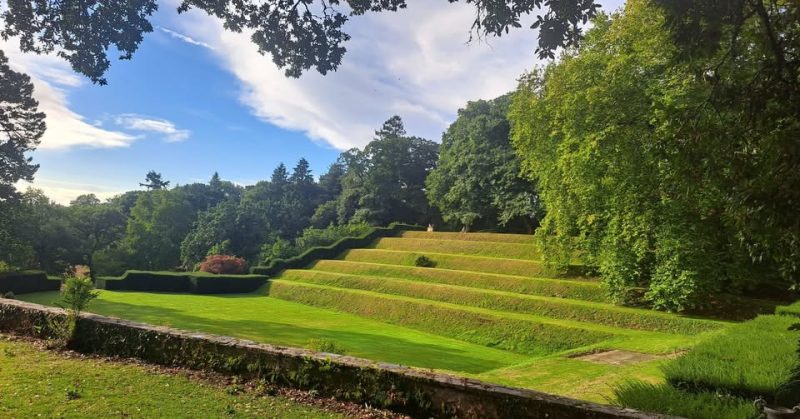
For all the complicated, wonderful, magical, and at times frustrating history, Dartington is much more than its past. It’s prepping itself for the future, a national and international future that is currently fraught with economic uncertainty and global unpredictability. Just as the Elmhirsts arrived bang on time, to revitalise the rundown decrepit estate, by bringing it back to life, the next chapter in Dartington’s history is yet to be written. Will it re-emerge like a phoenix rising from the ashes, ready to contribute creative solutions to today’s complex social and cultural challenges? Or will it fade into the dark shadows, happily content with obscurity?
Nobody who implicitly knows the depth and breadth of Dartington’s rich and diverse history, believes for one moment that the estate will settle for mediocre and anonymous. As a maverick and professional chameleon, Dartington doesn’t know how to do normal, even if it tried. If you know anything of its multi-dimensional character and tenacity, if you have read all the books on Dartington’s illustrious past, you’ll know it’s a fighter who won’t give up its cause for existing easily. Dartington is the pioneer, the luminary, the seer and the change-maker. It is a mentor, guide and inspired teacher to many. Maybe it does dither and flip-flop, endlessly, but once it makes up its mind to move to move into action, nothing can contain its boundless imagination.
On my office wall, sits a quote by present CEO of Marks & Spencer, Stuart Machin, who has performed one of the most successful reinventions and miracles in British retailing of late. ‘Protect the magic, and modernise the rest’, he told staff and stakeholders when taking the helm. I’ve always imagined the new turnaround team, along with long standing, committed staff at Dartington, working to the same principles. With tough, courageous choices, coupled with awkward yet vital conversations, they are steadily reimagining Dartington Trust anew, without forgetting the magic, vibrancy and change-making transformations that define this unique place.
Gratitude for the time and energy you put into this heartfelt article, Bill. I found it highly informative and it feels trustworthy. 🩵
❤️ 👌 ❤️
Carmella B’Hahn
An excellent item by Bill Murtha.
Yes – what might yet unfold at Dartington ? As a small but significant “Chakra” or natural Power Point on Earth,with a Global Resonance, (a matter well understood by William /Bill Elmhirst , now no longer with us…) a sensitive venture at Dartington,at the appropriate time, could contribute, further, significantly, as we enter a transformative, Paradigm -shifting epoch on our Planet.
With – International conferences and gatherings – on the theme,perhaps:- “One Planet, One People” – to encourage Global healing, friendship and fruitful intercommunication.
The Aller Park Project of 2016-18, with part-renovation of 3 of the rooms, and offering – Education, Healing, discussion – in preparation for the “New Earth”…as the many who participated found,was a small but useful step in that direction.
Astrology – that venerable Art – certainly indicates the possibility of a new phase entirely, especially during 2028, at, and concerning Dartington. With estimations based upon Astrological Charts and data relating to Dartingon from the March 1925 “Discovery” of the Estate by the Elmhirsts, and from the declaration of the Trust in late July 1932.
Would be glad to discuss and elucidate further for the sake of those interested in this topic.
Hello David, good to hear from you Sir.
Great post.
Few have a better grasp of Dartington’s significance and possibilities for the future than yourself and your dearly departed friend, William Elmhirst.
Yes, with the practical and transactional foundations being steadily laid down first, Dartington is hopefully gearing itself up to create that fertile ground again for future meet ups, conferences and retreats of like-minded hearts-all committed to pioneering social and cultural projects. For the betterment of all, and not just the few.
So much global upheaval is happening at present. On unprecedented levels. More than we can sometimes digest. And as we’ve seen with many other such pivotal times, certain people, places and groups usually rise up to the challenge at such uncertain, scary and heady times.
Let’s hope and envision Dartington playing its key role once again with what lies ahead for society and the massive shifts happening fast. There’s rarely been a better role model, going by its century long track record around new ideas and imagination, even allowing for the last several decades when Dartington has remained a sleeping giant ready to reawaken.
Take care, David.
Yes, Bill, a sleeping Giant indeed…. and when he/she ?? arises from slumber – to what music shall we move ?- Enigma Variations (cont.) ?, Ode to Joy ? or, even “Imagine”…Incidentally, Dartington already has a”voice” – Soundart Radio. My show:- “One Planet, One People”, does venture into the territory of Possible Futures; Local,Universal.Next broadcast Thurs. 28 May 1-2 p.m.
An illuminating and informative open letter which lays out very clearly the difficulties of running this beautiful and much loved estate. No mention however of the large number of hard working volunteers who help to keep the place going at no cost to the estate!
Hi Gill, thought I had mentioned the great volunteers, when talking about Peter Nicholson and others. But you’re dead right. The unseen heroes do need even more of a shout out and recognition for all the amazing free time and energy they have committed to the whole Dartington estate over the decades.
No different to what the various volunteers like Wendy Stayte and many others have magically done around Totnes and Dartington. We’re fortunate to have such an empathic and compassionate culture and local community.
😊