
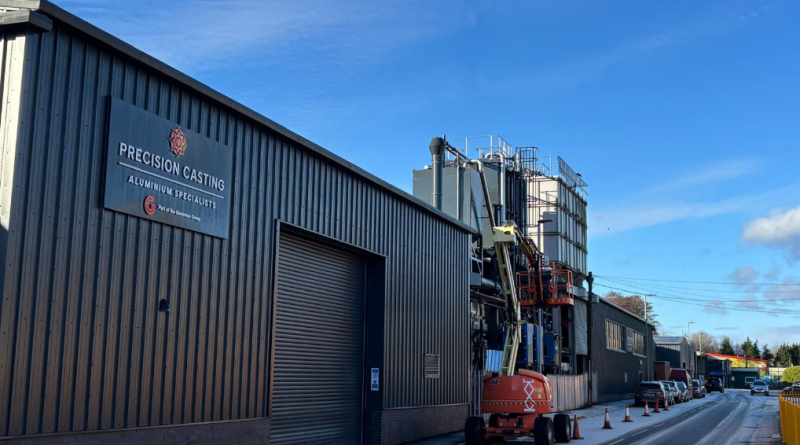
Peer of the realm backs manufacturing revamp with £6m investment
Look out soon for an unlikely invitation – to a building on Totnes’s industrial estate that since its establishment in the 1950s from a disused racecourse has seldom been regarded as a visitor attraction.

The destination is what amounts to a new factory on the site of an outdated metal-castings plant for making industrial parts. The £6m revamp is a big leap of faith by the plant’s owner, who turns out to be not a conventional industrial enterprise but the 10th Viscount Falmouth, otherwise known as Evelyn Boscawen, a wealthy Cornish landowner. The investment is a sizeable bet by the 70-year-old – whose title dates to the 17th century – that the Totnes factory can hold its own in a sector of manufacturing where rivals from lower-cost nations led by China have pulled ahead.
this plant has a good future
“Viscount Falmouth has wanted to modernise the plant for some time,” says Matthew Gazzard, managing director of Goonvean, a company controlled by the peer that owns the factory. “He just needed to find the right way to make it happen.” Now – so enthusiastic are the factory’s managers that it has a decent future – that they are mulling over a plan to open it up to people such as school leavers who might like a job there, plus anyone else interested. “We’d like to go to schools and colleges to tell young people that while castings plants have not had the best reputation as places to work, with modern technology things are different,” says James Mullins, the site’s managing director. “We’ve moved away from this being a dark and dismal industry. With the investment virtually complete, we can make a case to potential employees and others that we’re a high-end technology-based operation with excellent prospects.”

Amongst the factory’s existing and potential customers, interest has already been heightened, according to Gazzard. “When we bring people from other businesses to the site, they say ‘Wow, this is something we really want to take notice of’. We have a host of blue-chip companies keen to talk to us. They are starting to recognise that there are very few locations in the UK comparable to this one that can make high-quality products of the sort we specialise in.”
The factory has its origins in Foundry and Fabrication, a family-owned castings company started in Totnes in 1962. The plant occupies a prominent position on the industrial estate – established after the Second World War on the site of the town’s former horse racing track near the River Dart – but had received little new investment and was in a poor condition. Racing on the site started in the early 19th century but halted in the 1930s.

Goonvean – based in Cullompton near Exeter and which owns subsidiaries in businesses from aggregates to software – bought the factory in 2016 and renamed it Precision Casting. It started the modernisation project about two years ago. The plant makes aluminium castings using a well-known process called sand casting. Complex metal objects are produced using moulds built up from compacted sand, with the shapes created using specially made “patterns” which replicate the object’s shape.
While traditional sand casting is based around labour-intensive methods for the handling and manipulation jobs required in the process, the Totnes factory has introduced automation to speed up production and reduce the need for shop-floor staff. “With our investment we’ve seen a sixfold increase in productivity compared to a few years ago, making possible a big increase in output without the need for extra workers,” Gazzard says.

At the same time quality has increased, with the new machinery making possible more precisely shaped components. Typical products from the factory include parts for valve casings or gear boxes. They are sold mainly to UK-based industrial businesses in sectors including military and construction equipment, rail and marine. Goonvean’s investment has included spending on machinery to increase recycling of the sand used in the casting process and of metal residues, while a large percentage of the plant’s electricity comes from the small hydroelectric station on the Dart.
castings plants have not had the best reputation
The factory’s output is focused on relatively high-value components weighing a few kilograms and made in low production runs. “We’re set up to make high-precision parts to meet specific customer orders, in batch runs of no more than 20-30 at a time,” says Mullins. “We’re not in the business of high-volume production which we leave to other companies.” While Precision Casting now accounts for about 5 per cent of Goonvean’s annual sales, Gazzard expects this proportion to double in the next two years. Goonvean last year had sales of about £80m and employs just over 500 people, of whom just 38 work at the Totnes plant, down slightly from 2022.
While this employee number sounds small, a key point is that a modern factory with automated machines in a high-cost economy such as the UK generally requires only relatively few workers. If the plant had more shop-floor employees using more labour-intensive methods, the chances are that costs would spiral and it would struggle to survive in a competitive world. Even so, given what he thinks are the good growth prospects, Mullins is expecting a “small” increase in employment in the next year or so, with additional business requiring perhaps five additional workers.

Summing up how he sees the years ahead Gazzard says: “I think many UK manufacturing businesses have realised they’ve become too reliant on long and complex supply chains that are prone to disruption, not least because of security concerns. There’s now greater interest [among UK industrial firms] in buying components from companies closer to them geographically, rather than relying on parts shipped in from far away. If we can maintain quality and control costs, I feel this plant has a good future.”