

Fred Mulder – The Art of Giving
Totnes as we know is home to many extraordinary people but there cannot be more than one person who fits this description:
- He has a CBE for services to philanthropy:
- He is a world expert on European printmaking.
- He sold the most comprehensive collection of Picasso linocuts in the world for $20m.
And he gave half of that fortune away.
Thanks to Fred Mulder, environmental, social change and justice campaigners around the globe have been helped to make the world a better place. “I have three children and four grandchildren. If you don’t leave the world in as good a state as you inherited it, you are stealing from future generations,” he told Totnes Pulse at his home in the town. “What right do we have to leave future generations a less habitable planet than we inherited?”
I’m a kid from a little prairie town
It all began in his home province in Canada, Saskatchewan, where as a member of a church he was used to giving a tithe – ten per cent of anything you earned– to church causes. “If you start when you are young you just factor it in.” When he lost his religious faith, he carried on giving anyway, directing his interest towards human rights and environmental issues, latterly concentrating much of his limited firepower on climate change issues. “Recently I have got interested in natural climate solutions, including rewilding, part of which is the reintroduction of the beaver, absent from the UK for the last 400 years. As a Canadian I’m sentimental about them – they are one of our national symbols – and they are very hard working water engineers. So we gave early support to the Beaver Trust and then River Action. English rivers are in a terrible state, it’s a national embarrassment.”
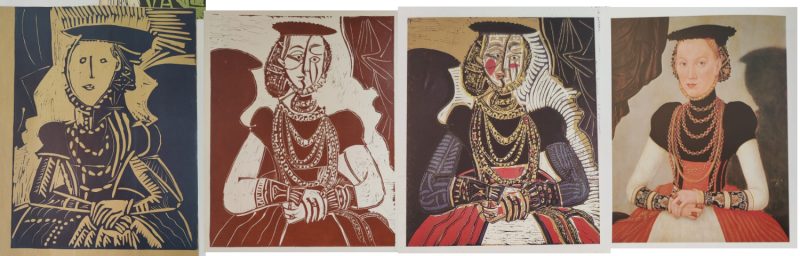
“Portrait de Jeune Fille, d’après Cranach le Jeune”. A fascinating insight into the workings of Pablo Picasso. The image on the far right is of a painting by Lucas Cranach the Younger who died in 1586. The image on the far left is the first version of Picasso’s linocut interpretation of the picture. The second from left is the rare first state of Picasso’s 2nd version. (Both linocuts in Fred Mulder’s collection. A similar impression of the 2nd image from the left sold in 2019 for $225,000). The third from left is a photograph of a final state of this version, which is printed in five colours.
Fred’s name is on his print business, as well as the Frederick Mulder Foundation, which gives grants totalling £600,000 a year. He also founded The Funding Network (TFN), which does live crowdfunding for social change issues , and which has spread to 25 countries. Last year the “Mothership”, TFN London, supported 30 small charities who pitched in front of “friendly dragons”.
The events raised over half a million pounds for those charities, located both in the UK and abroad. (Indeed the REconomy Forum Totnes holds each year is similar to TFN and Fred did support the Totnes Pulse at the Forum last year.) “We have raised about £18m now, virtually all in small donations.” One recent notable success has been with Appeal, which fights miscarriages of justice. Appeal commissioned DNA evidence which proved that Andrew Malkinson did not commit the rape he was found guilty of, and for which he spent over 17 years in jail. Thanks to this evidence Mr Malkinson was finally freed.
So how did Fred build his fortune?
It started with Fred coming to Oxford to write his dissertation for a Doctorate from Brown University, under the supervision of an Oxford University Professor who had expertise in Fred’s subject , and using part of his Canada Council Fellowship to buy original prints while living very cheaply. When the Doctorate was finished Fred decided to set up in business as a print dealer rather than returning to Canada to teach. A while later he caught the eye of Jacob Rothschild, the banker, who also owned renowned dealers Colnaghi on Bond St, and who offered Fred a job.
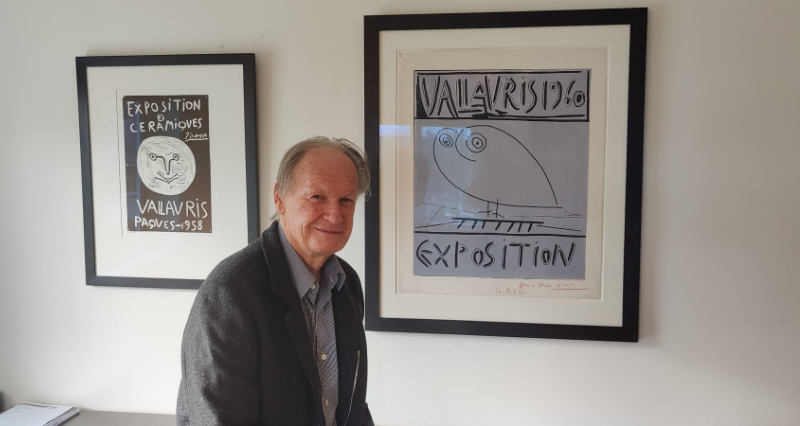
He turned the job down twice before negotiating a profit share and accepting the position. “It was not an easy transition” Fred remembers. “I’m a kid from a little prairie town who hadn’t had a proper job. I’d been in university for nine years, done three degrees, so to work for someone of Jacob’s stature and expectations was difficult. He wanted the business to run like a bank, but art dealers tend to be very independent minded. I left Colnaghi after three years and went back to working for myself as a private dealer”
Nevertheless Fred was able to do well for both the firm and himself during his years there, so by the time he met the person who introduced him to the Picasso world in the late 80s, he was well established. “I was going to Paris several times a year because I dealt with prints by Toulouse Laurec, Miro and Picasso, among others, when I met the art scholar Brigitte Baer who was in the midst of writing the six volume catalogue of Picasso’s printmaking. We became friends and she started introducing me to people in Picasso’s world, including several of his children and grandchildren and, importantly, to some of Picasso’s printers and their families.”
What right do we have to leave them a less habitable planet?
This charmed circle included Hidalgo Arnera, the French printer who printed all 197 of Picasso’s linocuts. He owned a print shop in Vallauris, where Picasso lived. “I started by buying one Picasso linocut (a Cranach) from Arnera and selling it to a museum. A few months later Arnera called from the South of France and asked if I would like to buy some more prints.” Fred continued to visit and buy regularly, and one series of purchases was made when Arnera needed money to help his son build a new house.
While the signed and numbered editions of the linocuts had gone on general sale, the impressions belonging to Arnera were his by virtue of the tradition that the printer was allowed a small number of prints from each edition he printed.
“Picasso was a very fine draftsman; he never rested on his laurels, was always experimenting. He was very brave in what he did artistically.”
Fred’s relationship with the printer lasted more than 20 years and when Arnera died, Fred was one of just two people from outside the town who was invited to his funeral. Later Fred was invited to purchase material from the estate, and after a number of trips to purchase material he realised he was on course to have the largest collection of Picasso linocuts in the world – “By the time I was finished I had 193 of the 197 linocuts which Picasso produced. None of Picasso’s heirs had as many as the prints left in the artist’s hands at his death had been divided up between them, whereas Arnera had kept all his.”
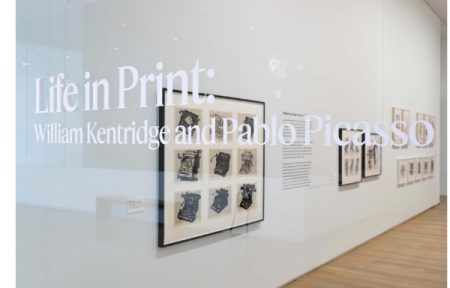
Back in Canada, a very community-minded woman, Ellen Remai, had given millions of dollars to build a modern art museum in Saskatoon in Fred’s home province of Saskatchewan. Named Remai Modern it was the perfect place, Fred thought, and Ellen agreed, for a home for his collection, and a coup for a small city. In 2012 Fred sold it to Ellen’s foundation for $20m, and almost immediately gave $10m of that to his charitable foundation. That money is still going around the world doing good.
Getting to Devon
In 2022 Fred and his partner moved out of London and as they had family in the area, they settled in Totnes. “I like the fresh air. I live near Northgate and the Castle, and I like the higgledy piggledy nature of it, the curves of the arches and the roads. Everywhere you look is a surprise and a delight for the eye. It feels very organic and unplanned.”
Now 81, Fred is still very much still involved with the art world, his Foundation, and The Funding Network, which has now spread to 24 countries, many of them visited by Fred for their initial events. On the art side, his firm is one of the sponsors of Picasso Printmaker, the show now on at the British Museum till the end of March. “I sold my first print to the British Museum in 1980 and have sold or given the museum 65 prints over the years; we have had a very close relationship”
He feels there is still much to do. “I had given money to Greenpeace and in 1985 the Rainbow Warrior had been sunk. I asked Greenpeace why they weren’t using the fact they were always in the news to raise money? I offered to underwrite an advertising campaign that made money for the charity right from the start. It taught me that one thing a funder can do is to take a risk on behalf of a charity who can’t.”
Not surprisingly Fred is dismayed with the way the Trump administration is handling things, from “Drill Baby Drill” to making unwelcome overtures toward Canada. “When the Paris Accords were passed I thought the world was on course to end its addiction to fossil fuels. Now that feels like a distant memory. As for his overtures about Canada – I would be offended if it weren’t so laughable. There’s no way Canadians are going to become the 51st state”
Fred’s foundation and The Funding Network are set to continue for years to come and perhaps there’s never been a more urgent need for Fred’s kind of philanthropy than now.
Interview with Peter Shearn and article written by Zoe Clough